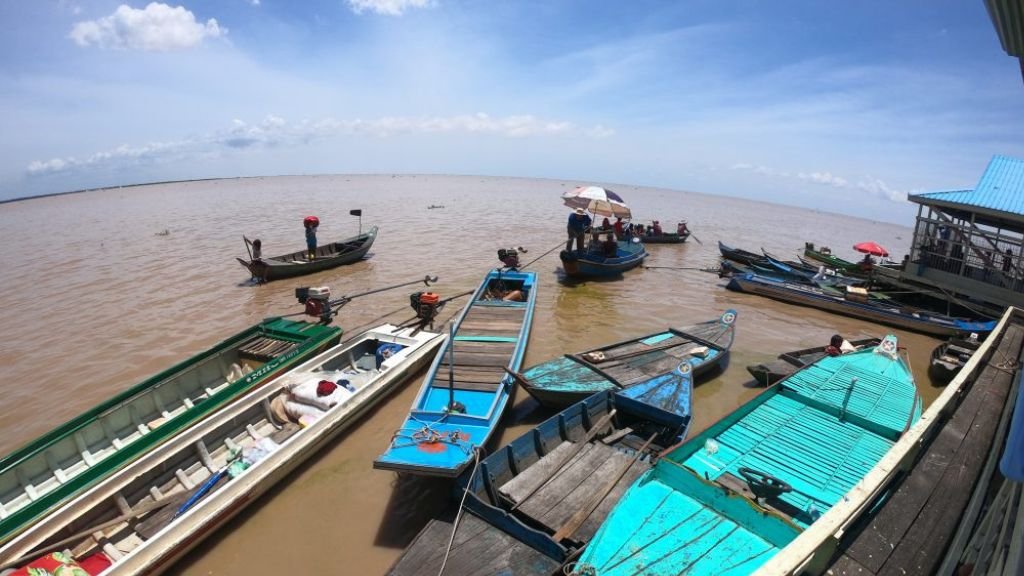
The following is a Cambodian news report republished here because it concerns the floating-home families IHM serves on the Tonle Sap River. Original reporting credit pending source confirmation.
Kampong Chhnang deputy provincial governor Sun Sovannarith reaffirmed that the 40ha the provincial authorities allocated to Vietnamese boat people is Cambodian national Ros Chamroeun's private land.
He said there was no cutting of land for them — but the Vietnamese immigrants will have to pay rent to live in the location with no right to own it.
Sovannarith on Thursday spoke at a press conference at the Office of the Council of Ministers about the relocation plan for Vietnamese, Cambodian, and Cambodian-Muslim boat people to relocate to the 40ha.
The press conference was called to explain that the relocation of boat people in nine communes who live on the water of the Tonle Sap River was so that they could live on land — as per the preparation by local authorities in Kampong Chhnang province.
The two-tier arrangement.
Sovannarith said Cambodian and Cambodian-Muslim nationals who volunteer to relocate from their floating houses can receive a plot of land measuring 5m by 20m per family.
Meanwhile, Vietnamese nationals have no right to receive the land — but can choose to rent it from owner Chamroeun and live on it.
Sovannarith said: "It [will be] an agreement between the landowner and tenants — and the rental [fee] depends on how big or small the house is."
After relocating the boat people, the Kampong Chhnang provincial authorities will transform the location into a tourist area — and set up fish- and lobster-raising cages as per European technical standards, he said.
The administrative report.
A provincial administration report released at the press conference said the land was owned by villagers and they had sold it to private companies.
The report said the provincial administration received public roads — and land for building schools and health centers, among others.
The private companies make a profit legally, while people who relocate to the land can choose to buy or rent a place at a reasonable price.
"For Cambodian and Cambodian-Muslim nationals, the provincial authorities had arranged for all of them to live on land in their respective villages and communes — by just moving from water to land."
"The authorities will prepare roads, electricity and clean water, schools, and health centers for them as per the requirements," said the report.
The report said that as long as the Vietnamese boat people are legal immigrants, they can live in the Kingdom.
And, the government, relevant ministries, institutions, and provincial authorities have to care for their living in accordance with Cambodia's law on immigration and international laws.
The numbers.
The report noted that there are a total of 4,563 families living in floating houses on the Tonle Sap River in Kampong Chhnang province.
9,168 people
242 people
10,311 people
The Vietnamese families are the largest group — and the only group denied the right to own land.
The Kampong Chhnang provincial administration's report cited the reason for this relocation as "to make the living of people sustainable and be in line with land law to sustain Tonle Sap River's environment, natural resources, and biodiversity."
This is in hopes of strengthening security and public safety — and participating in preventing crimes that destroy natural resources, especially fisheries.
Rights groups respond.
Rights group Adhoc coordinator in Kampong Chhnang Sam Chankea said that he welcomed the relocation of the residents.
However, he has not received information on whether the 40ha belonged to Ros Chamroeun.
"We are unsure whether the land belongs to anyone, and have not followed up in regard to it. We also don't know how they would rent the land." — Sam Chankea, Adhoc Kampong Chhnang coordinator
Why we're sharing this.
The 2,480 Vietnamese families described in this report — 10,311 human beings — are the communities IHM serves. They are the families whose children attend our school. Whose mothers receive our medical care. Whose grandfathers receive our toilets.
This article documents the policy reality they face — a relocation plan in which they alone, of the three groups affected, have no right to own the land they are moved to. Stories like this one are not pleasant to read, but they explain exactly why IHM's work — and your support — matters so much.