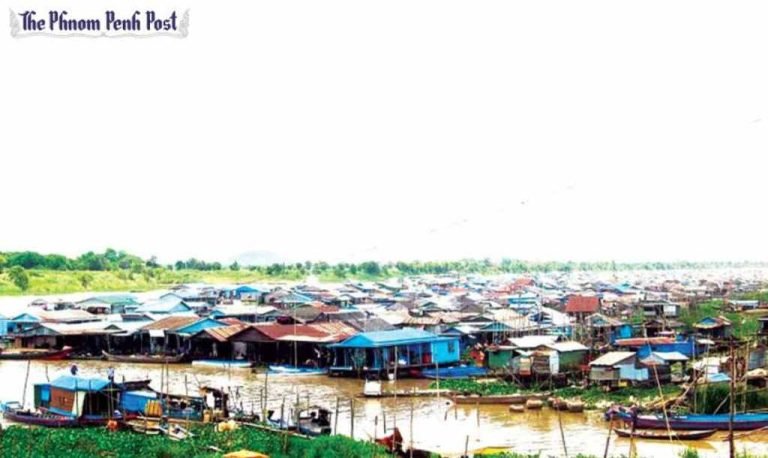
The following is a report from The Phnom Penh Post republished here because it concerns the families IHM serves on the Tonle Sap River.
Interior Minister Sar Kheng on Thursday defended the actions of Cambodian authorities in relocating Vietnamese nationals living in houseboats on the Tonle Sap river in Kampong Chhnang province — saying the "volunteer" policy came on the back of "environmental" concerns.
Sar Kheng, who is also Deputy Prime Minister, was commenting after Vietnamese Foreign Affairs Minister Pham Binh Minh was quoted in the state-run Vietnam News Agency on Tuesday — saying that many members of the community have been moved to a new resettlement area where "living conditions are not ensured."
During a ceremony to congratulate the new Tbong Khmum provincial governor, Cheam Chansophorn, at the provincial hall on Thursday, Sar Kheng said that in principle, the authorities cannot allow people to live any longer at their floating village on the Tonle Sap river.
"An example for other places to follow."
"In Kampong Chhnang province, there were relocated people who live on Tonle Sap River… the reason is, in principle, we cannot allow them to build the villages or houses on the river," Sar Kheng said — calling the actions of the Kampong Chhnang authorities "an example for other places to follow."
However, Sar Kheng acknowledged that the move brought "challenges" and "difficulties" — but he said Cambodian authorities would try their best to "solve" the issues.
"We will work hard to solve the issues for the environment. [I] support this and encourage the provincial authority to do so… it is the volunteering, and [we] find appropriate places where they can live and support their livelihoods," he said — referring to the relocated as "Vietnamese immigrants."
"Please don't persecute or torture."
Sar Kheng instructed authorities not to "persecute" or "deport" people if they had not committed any crimes.
"First, please don't persecute or torture those who live in Cambodia. Secondly, there is no need to deport them — except if they have committed crimes in their own country and then fled to our country, or have illegally emigrated," Sar Kheng said.
"[We] relocated them there, and is their [standard of living] better than living in a floating home? It is impossible… but we will do our best on this issue without any discrimination."
Vietnam's diplomatic concerns.
Vietnam News Agency reported that during the meeting between Cambodian Deputy Prime Minister Prak Sokhonn — who is also minister of foreign affairs — and Vietnamese Foreign Affairs Minister Pham Binh Minh on the sidelines of the 33rd ASEAN Summit in Singapore, the official underscored that the Cambodian government hopes to continue "fostering ties" with Vietnam and will "create optimal conditions" for the community to settle down.
Pham Binh Minh said Vietnamese Prime Minister Nguyen Xuan Phuc had also requested Prime Minister Hun Sen "to support the Vietnamese-Cambodian community in leaving the area and stabilising their life in a new place," according to the news agency.
"[Nguyen Xuan Phuc] also asked for a clear roadmap to ensure their livelihoods and the availability of necessary infrastructures, such as schools and healthcare facilities."
Why we're sharing this.
This article matters because it shows the official Cambodian government position in the minister's own words — defending a policy that the UN, rights groups, and Vietnamese diplomatic officials have all raised concerns about.
It is also notable for what it asks of Cambodian authorities: "please don't persecute or torture those who live in Cambodia." That such an instruction needed to be given says something about the conditions the Vietnamese community was facing.
These are the communities IHM serves — the families described in this article, who now need schools, healthcare, and the most basic dignity in their new locations. That work continues. With your help.